Friday, 19 December 2014

A special friendship with the Lewin family

Dec 2009: Ali with
Ben (then 13), Marie (11), Malachy (7), Samuel (10) and Patrick (5).
with Amanda and Mark Lewin behind
When they heard about Ali's anniversary Requiem Mass, Ben, Samuel, Malachy and Patrick Lewin immediately expressed their desire to serve at it.

Ali had seen the boys grow up, and also Mark and Amanda Lewin's eldest daughter, Marie. Their youngest daughter, Grace, had only just had her third birthday when Ali died, but Ali was pleased to have been able to attend her baptism at the Oxford Oratory when she was a few weeks old. Ali was not well even then, and it was the last time she was able to travel to Oxford.

Nov 2010: after Grace's baptism
Her close friendship with Amanda and Mark meant a lot to Ali, and she had the love of a godmother for each of their children. It was a joy for Ali to be a part of their childhood, and she was delighted to let them borrow her wheelchair to ride in - or just  to sit in to play the violin, as Marie is doing in one of the pictures below.  Ali also had the joy of seeing the older ones mature into fine young adults.

Ali would have appreciated all the boys serving the recent anniversary Requiem Mass. The two older boys, Ben and Samuel, said it was an honour to be among those carrying Ali's coffin at her funeral last year, into and out of the Church and even to the burial.

Three weeks before Ali died, Marie came for a few days to help care for her.  Her presence lifted Ali's spirits and it was beautiful to see Marie's loving concern for Ali as well as the joy her presence gave Ali.

At the risk of embarrassing them with photos taken when they were younger, here are several photos taken over the years of Ali with members of the Lewin family who were so very dear to her.

Dec 1998: With Ben (then 2) and Marie (nearly 1)
Dec 1998: Ali with Amanda and Marie.
Aug 1999: At Weymouth beach -  with 2 month old Samuel too
May 2004: With Marie and Amanda's parents, Sheila and David
July 2004 - Patrick at a month old
July 2004: Samuel, Ben, Marie, Malachy - angelic!
May 2005: Marie's First Holy Communion
Nov 2006: the day of Samuel's First Holy Communion
Nov 2006: with Marie
Nov 2006: A 'moment' between Ali and Malachy
June 2007: Amanda with Ali
Nov 2007: With Ben and Marie after their Confirmation

Dec 2007: Marie in Ali's wheelchair with Malachy (left) and
would-be rocker, Patrick. Ali's feet got in too!
Dec 2009: With 10 year old Samuel.
2014 - the Lewin family today

Tuesday, 9 December 2014

Ali's first anniversary Requiem Mass

Anniversary Requiem Mass - 3 Dec. 2014
It was good to be joined by so many for Ali's anniversary Requiem Mass at Corpus Christi Church, Maiden Lane, London, last Wednesday (3 December). Some travelled long distances to be there.

Sincere thanks to Fr Brendan Gerard, FSSP, for making the arrangements for the Mass and for being the celebrant, and to Fr Tim Finigan and Fr Michael Cullinan who functioned, respectively, as deacon and sub-deacon.

The start of the Mass was delayed as the M.C. was unexpectedly unable to attend due to an emergency. He had the vestments for the deacon and subdeacon, and in his absence Mass had to proceed without their wearing the dalmatic and tunicle, as they would normally. Because Mass was late starting, Fr Brendan truncated his homily, but I am happy to post it in full below. It fittingly explains why we pray for the dead.

Ali's good friend Amanda Lewin has sent me some photos taken during the Mass.  The altar servers were her four boys, Ben, Samuel, Malachy and Patrick, who served with their customary reverence and competence.

_______________________________________________________________

Homily of Fr Brendan Gerard FSSP for the first anniversary Requiem Mass


Fr Brendan Gerard, FSSP
Prayer for the dead is attested in biblical Judaism, and as a late development. It’s mentioned in the second book of Maccabees, a book which the Catholic Church, by her apostolic faith, recognizes as inspired and canonical. 2 Maccabees dates from the latter half of the second century BC, and records events from the first half of that century. Even those who don’t accept the book as canonical can hardly deny its historical value as evidence for the belief and practice of at least one current of Judaism at that time. But why does prayer for the dead appear so late? Because it depends on belief in the bodily resurrection, which by the Maccabean period had been accepted by some Jews, the theological forefathers of the Pharisees, but not by all. Two centuries later, the resurrection was still contested by the priestly aristocrats known as the Sadducees.

In the passage from 2 Maccabees that we heard in this Mass, the army commander Judas Maccabaeus raises money to pay the expenses of a sin offering for his fallen soldiers who were found to have forbidden pagan images on their persons. “In doing this,” says the author, "he acted very well and honourably, taking account of the resurrection. For if he were not expecting that those who had fallen would rise again, it would have been superfluous and foolish to pray for the dead." (2 Macc 12:43b-44 RSVCE)

For this biblical author, then, prayer for the dead makes sense only if the dead rise again. The future life, as he – and, later, the Pharisees – conceived it, necessarily involves bodily resurrection. Our Lord supported the Pharisees on this point. The doctrine of the resurrection can be justified anthropologically: since man is soul and body, spirit and flesh, something would be wrong if, after death, a man were to exist forever as a disembodied ghost. From the biblical point of view, that we have to die at all means that something has already gone wrong, but that’s another problem. The fact that Jesus rose bodily from the dead is the proof that the body participates in the life of the world to come. In Our Lord’s thought, this truth is not only anthropological, but above all theological. Jesus justifies this doctrine on the basis of God’s self-revelation to Moses: “I am the God of your father, the God of Abraham, the God of Isaac, and the God of Jacob” (Exod 2:6). Abraham, Isaac and Jacob are God’s friends, and as such they can’t be thought of merely as dead patriarchs. “He is not God of the dead, but of the living,” says Jesus (Matt 22:32b & par). If the patriarchs are friends of the living God, they too are destined for life – and that implies the resurrection. Jesus himself, the Son of God, the first to rise from the dead to imperishable life, will be the agent of resurrection at the consummation of human history. The Gospel of our Mass, from John ch. 6, concludes with this “mission statement” from Our Lord: “this is the will of my Father, that every one who sees the Son and believes in him should have eternal life; and I will raise him up at the last day” (John 6:40).

The letter to the Hebrews warns us that the word of God is “sharper than any two-edged sword” (Heb 4:12), and the doctrine of the resurrection is in its own way double-edged. On the one hand, the hope of resurrection means that the catastrophe of bodily death is drastically relativized. Death no longer has the appalling finality that it has in the eyes of those “who have no hope,” as St Paul puts it (1 Thess 4:13). On the other hand, since bodily life will not be abolished but transformed on the last day, bodily life matters. That enigmatic truth of faith, the identity of the earthly body with the transfigured body, forces us to take bodily life seriously. That’s why we cannot remain indifferent to the killing of innocent people, however small, sick or old they may be. We can’t reconcile ourselves to it with an existential shrug. We can look at it philosophically, if you like – with that Christian philosophy that we find in St John’s Revelation. The souls of the martyrs under the altar cry out to God: “how long before thou wilt judge and avenge our blood on those who dwell upon the earth?” (Rev 6:10). And the answer? The martyrs are to rest “until the number of their fellow servants and their brethren should be complete, who were to be killed as they themselves had been” (Rev 6:11). In other words, killing God’s saints and innocents is the way world behaves, and we can expect it to carry on doing so, in one way or another, until God blows the final whistle. 

Belief in the resurrection, and the view of the human person that the resurrection implies, are convictions we shared with Alison, our friend. Before she was received into the Catholic Church, before she returned to Christian belief at all, Alison came to oppose infanticide and abortion in the light of natural reason. That, of course, was entirely correct. Even without supernatural faith, the human conscience is in principle capable of recognizing that to take innocent life is a very grave injustice. Belief in the resurrection confirms what reason already tells us: that the human being may never be treated as a disposable commodity, or as an expendable incommodity. That is also a lesson that Alison helped us to learn, with a pedagogy that was uniquely hers. Now she knows better than us not only what we see by the light of reason, but also what we know by revelation, that “lamp shining in a dark place, until the day dawns” (2 Peter 1:19). She has gone further than us on the journey to that city where “the glory of God is its light and its lamp is the Lamb” (Rev 21:23). Requiescat in pace

Does Ali need our prayers?

If it is my conviction that Ali is a saint (as I have said previously on this blog), is there any need to pray for her? And why should there be a Requiem Mass for the repose of her soul, as there was for her anniversary on Wednesday?

The best answer I can give to the questions is that the Church recommends that we pray for the dead, and there is no better prayer than the Holy Sacrifice of the Mass. The Mass is the sacramental perpetuation of the sacrifice of Jesus Christ on behalf of fallen humanity, so that our sins may be forgiven and that we may be able to live in union with God - imperfectly on earth and perfectly in heaven. It is only through that Sacrifice that the possibility exists for Ali to be in heaven.

A Requiem Mass expresses the desire that the particular person or persons being prayed for may be united with God in heaven.  It may well be that the desire expressed in the Mass has already been fulfilled. If I recall correctly, St Pio of Pietrelcina  (Padre Pio) said that he offered Masses for the repose of the soul of his mother even though he knew she was in heaven - because he knew that her early admittance to heaven was in anticipation of those Masses.

The Church recommends that we pray for the dead because most of us are not ready to meet God face to face when we die.  We need to be purified to become ready for eternal union with God. This purification - called purgatory - is understandably regarded as a period of trial and suffering. In his beautiful poem, The Dream of Gerontius, Blessed John Henry Newman describes the journey of a soul to God, and mentions that the period of purgatory is aided by Masses on earth and prayers from heaven.

There is a part of the Dream of Gerontius that strikes me each time I read it, and especially when I hear it in Elgar's setting of it. The soul of the old man who has died (Gerontius) has the briefest of glimpses of God and in that instant recognises his unworthiness to enter into God's presence, and his need for purification:


Take me away, and in the lowest deep
              There let me be,
And there in hope the lone night-watches keep,
              Told out for me.
There, motionless and happy in my pain,
              Lone, not forlorn,—
There will I sing my sad perpetual strain,
              Until the morn.
There will I sing, and soothe my stricken breast,
              Which ne'er can cease
To throb, and pine, and languish, till possest
              Of its Sole Peace.
There will I sing my absent Lord and Love:—
              Take me away,
That sooner I may rise, and go above,
And see Him in the truth of everlasting day.


Much of the reason for my conviction that Ali is already in union with God in heaven is that I believe she experienced on earth much if not all of the purgatory that most of us require after we die. She had experienced God's love and mercy, and she sought to love Him with all her heart, mind and strength, which she demonstrated in loving others, at great personal cost.  She had an appreciation of the awesomeness of God, how much (in fact, everything!) she owed Him, and of her littleness in relation to Him.  Ali was profoundly humble.  Far from believing that she had 'achieved' anything in life, her tearful lamentation on the Saturday, three days before she died, was "I got everything wrong."  

It is my understanding that the Church does not allow eulogies at funerals (even though they sometimes take place.)   In any case, Ali had specified that there should be no eulogy at her funeral. She knew that praise would be of no benefit to her,  and she anticipated (rightly or wrongly) that, like others, she would need prayers to assist her after death.  

There is a tendency nowadays to proclaim that those who have died instantly enter heaven, in which case there is little else to do than sing their praises.  Many lose sight of the fact that those who have died normally need purification and are aided by our prayers.  I believe that Ali is among the greatest of the saints in heaven, but that most of us are likely to need a period of purification before becoming among the least of the saints in heaven.

In due course the Church will decide whether to investigate Ali's cause for canonisation.  Only the act of canonisation itself is a definitive, infallible act of declaration that someone is with God in heaven, though the earlier stages of the process (during which the person under consideration is given progressively the titles Servant of God, Venerable and Blessed) reflect the Church's growing conviction that he or she is.

I can express only my personal conviction, but I cannot say infallibly, that Ali is a saint in heaven. The Church encourages us to pray for the dead, and I agree with that wise encouragement.

Wednesday, 3 December 2014

In Paradisum


Fauré's beautiful setting of the "In Paradisum" expresses the desire for eternal bliss that we have for our loved ones who have gone before us.

One year ago today, on 3 December 2013,  at 8.40am, Ali entered into eternal life.  I find it impossible to believe that the angels and saints did not welcome her joyfully into the paradise of eternal union with God, which she had desired so ardently and for which she had prepared so lovingly.

In paradisum deducant te Angeli;
 in tuo adventu suscipiant te martyres,
 et perducant te in civitatem sanctam Ierusalem. 
Chorus angelorum te suscipiat, 
et cum Lazaro quondam paupere 
æternam habeas requiem.

May the angels escort you into paradise;
 at your coming, may the martyrs receive you
 and bring you into the holy city, Jerusalem. 
May the chorus of angels receive you,
 and with Lazarus, once a poor man,
 may you have eternal rest.

Ali - in 1995

Monday, 24 November 2014

Living and Dying with Dignity

The last photo of Ali was taken on 24 November 2013

As the first anniversary of Ali's death approaches, it is inevitable that thoughts go back to the events of last year.  The last photo of Ali was taken on this day last year when she enjoyed a visit from her sister, Tina, and brother-in-law, Tony.   

Ali cheerfully joined in singing 'happy birthday,' and helped me to blow out the candle on a lovely chocolate cake Tina had made.  I felt quite choked, realising that it would be the last birthday candle Ali would blow out.   She would have enough breath for nine more days.

There is currently discussion in Parliament of Lord Falconer's Assisted Dying Bill. If enacted it would enable  patients, who are judged (rightly or wrongly) to have a life expectancy of less than 6 months, to commit suicide by obtaining prescription drugs to end their life.   

As is well known, Ali frequently wrote and spoke in the media (from about 6 mins 30 secs on the linked clip) against any form of "assisted dying" or "assisted suicide" or "voluntary euthanasia." She spoke against it with compassion, knowing well that life can be wretched and that death can be appealing - as it was for Ali for several years. She knew that if Lord Falconer's Bill, with its risible 'strict safeguards,' had been enacted thirty years ago she would have qualified to be killed in the late 1980s when life was at its lowest for her and when doctors thought she had less than six months to live.

It would obviously have been a tragedy if an "assisted dying" law had facilitated Ali's death nearly 30 years earlier.  And, of course, if Ali's life had been ended then nobody would have known that she could have lived for many years, and would have come to find a meaning and value to living, even though her physical and other difficulties continued.  But it would also have been a tragedy if an "assisted dying" law had cut short Ali's life even for those last nine precious days.  

Ali objected to the way proponents of assisted suicide have hijacked our language - the mantra of 'dying with dignity' has led to an increasingly widespread attitude that if you are terminally ill or disabled you can only have 'dignity' if you are killed.  The final days of Ali's life, which included much suffering, were lived with great dignity and she died with great dignity - a far greater dignity than those who choose 'the easier way out'  of suicide.

In September I was invited to speak at the national conference of the Society for the Protection of Unborn Children (SPUC) on the subject:  "Suffering for what we value: the legacy of Alison Davis." In concluding the talk I said a little about Ali's last days.  It seems fitting to reproduce now what I said then:

I haven’t spoken of Ali’s opposition to assisted suicide or euthanasia, mainly because I want to make just a single point now on this topic.  I don’t think it will be helpful as a public argument but I think it is something that needs to be learned and incorporated into the lives of those who don’t accept killing as the appropriate response to human suffering.    The point I want to make – which was Ali’s unspoken lesson to me in her final days – is that a painless death, without difficulties, is not really what matters.   
Ali had a week of respite care in the local hospice in October of last year and then spent the last six weeks of her life at home.  Some time after getting home she was unable to get out of bed even to go to the bathroom.   I was struck by the fact that, though it was a time of upheaval and of momentous change, it was a very peaceful time.  It sounds strange to say but – paradoxically – it was possibly the best six weeks of my life. 
When it was clear that Ali was dying a number of friends visited.  They normally had to wait a while to see her and then it would be for just a few minutes.  Ali had pain and was exhausted and her ability to interact was limited, but she was joyful.  The final photograph of her [above] was taken with me on 24 November, nine days before she died.
I want to stress that Ali received excellent care from our local GPs, nurses, health care assistants, and also from our local hospice.  They were faultless.  They were concerned that Ali was in too much pain. At best it was bad enough; at times it was extreme.  However, it seemed to me that, paradoxically, the more they tried to ease her pain the more she had.   This was especially after they put her on a syringe driver four days before she died.  The only way to be painless would be if she were totally zonked out, which she didn’t want.
Ali died at home on the morning of Tuesday 3 December.  She lost her swallow reflex on the Sunday night.  So from then, she could no longer take even small drops of liquid to drink; or liquid morphine for pain.  She would generally wake up for short periods, with pain coming soon after she was awake.  
About 8pm on the Monday night, after being awake for an hour or so, the pain was so extreme she wanted me to call the out-of-hours doctor.  It was known that if she called the out-of-hours service, Ali would receive an injection of diamorphine which she duly received and it zonked her out in seconds.  Knowing that she hadn’t had liquids for nearly 24 hours, and expecting that the diamorphine would last some time, it seemed to me that Ali might die without waking up again.
I was surprised, then, when Ali woke up at 1am.   She could say little – a few words at a time.  Often she would respond just 'yes' or 'no' to my questions.   It was soon clear that she was in pain. 
-  Do you have pain? "Yes."  -  Is it very bad?  "Yes." - Do you want me to call the doctor to give you something?  "No."   I frequently asked her if she wanted me to call the doctor to help with the pain. She always said "no".  I would ask:  - Are you happy?  She always said, and you could read it in her eyes: "Yes!" 
Ali once said that our life in the world is like that of an unborn child.   In a way ,we are unborn.  The unborn child knows only the womb.  He or she doesn’t know the marvellous world that lies beyond the womb. The suffering of his mother accompanies the child into the world – and it is traumatic for the child.  The world, Ali said, is like a mother’s womb.  It is a preparation for what lies beyond.  What lies beyond is so much beyond our imagination, just as the world is beyond the imagination of a child in the womb.  Just as suffering accompanies our entrance into the world, so it is fitting that it accompanies our exit from the world.  We prepare for what lies beyond.
I am convinced that Ali didn’t ask me to call the out-of-hours doctor again, because she knew that if she received another injection of diamorphine she would be zonked out for the rest of her journey into the next world.  She didn’t want that.   She wasn’t clinging on to life, afraid to let go – the sentence she said more than any other in her last weeks and days  was “I want to go home.”  She was anticipating her eternal destiny – but she knew she wanted to take with her as much as she could.  And what can we take with us?  Not material goods – but  the treasures of our good actions, our prayers, our suffering,  our love.
How precious were those last hours of Ali's life!  The good deed she performed then, contributing to the treasures she took with her, was a final lesson to me - and, through me, to you and others - how to die with real dignity and courage.  She prayed - expressing sorrow for the things she got wrong in life - and offered up her suffering to God, in loving gratitude for the life she had been given, and for  all His love and mercies. 
Ali amassed all the treasures she could of good deeds, prayers, suffering and love - while she had the opportunity to do so.  And for some silly reason she loved me and wanted to spend as much time as she could with me. 
 So she didn’t want me to call the doctor to zonk her out. She wanted to be sat upright in the bed – which ensured that she would live longer – and for me to hold her.  I encouraged her as best I could. We prayed.  Her body gradually wound down in a way I had never experienced before and eventually she lost all ability to communicate.. I believe though that she remained conscious, and could hear the ongoing encouragement and prayers, until the end.   Ali died at 8:40 in the morning.
She could have died easily and painlessly, but chose a far happier death of suffering with great love.
As I said [earlier in the talk], I’m a wimp.  But I hope I can learn from Ali to be willing to suffer lovingly during life and especially at the end of my life.
Ali was small - four foot something and getting smaller as her spine collapsed. But she walked head and shoulders above us all.

Tuesday, 11 November 2014

1st anniversary Mass in London - Wed 3 December

Corpus Christi Church, Maiden Lane
It is hard to believe that nearly a year has already passed since Ali died, and yet it is far too long since she was with us.

The anniversary of Ali's death falls on Wednesday 3 December.  Her friend and pro-life colleague Fr Brendan Gerard has very kindly arranged for an anniversary Solemn Requiem Mass to be sung on that day at 6.30pm at Corpus Christi Church, Maiden Lane,  London WC2E 7NB.  The nearest tube station is Covent Garden.

Fr Brendan will be the celebrant of the traditional Latin Requiem Mass (1962 Missal) with Fr Tim Finigan (deacon) and Fr Michael Cullinan (subdeacon).

All are very welcome to attend.

Tuesday, 3 June 2014

Looking back

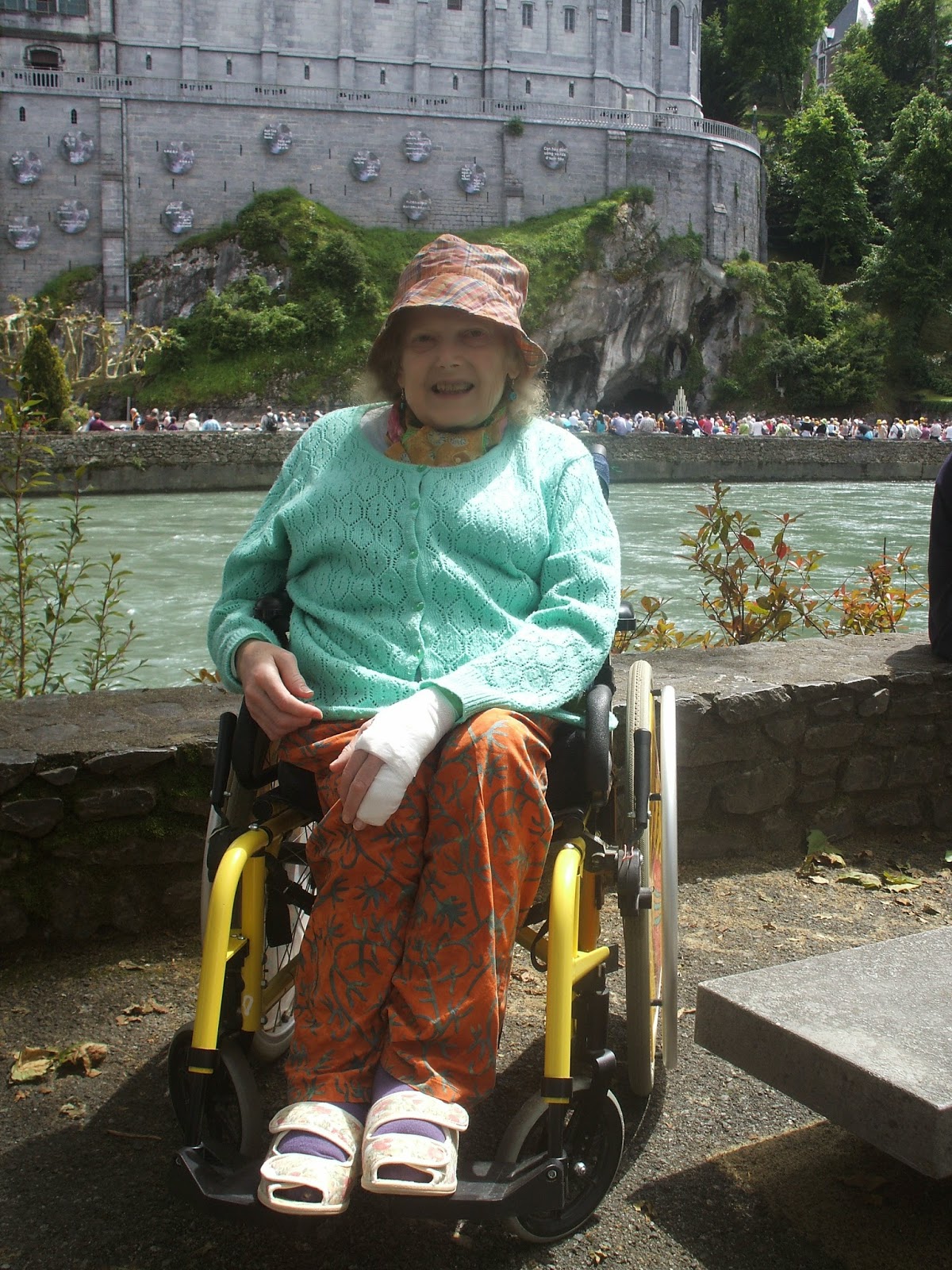
Lourdes -  June 2013
Just a short post. Maybe it doesn't say much - and I realise that still this blog hasn't really even begun to say what needs to be said about Ali.  I have found the past six months a period of upheaval, in which I have wanted to reflect on various memories before beginning, as I know I must  in due course, to share them with others.

Today marks six months since Ali's passing into eternal life on 3 December 2013.  Six months earlier, on 3 June 2013 we arrived in Lourdes after an arduous 8-day car journey through France.  It was so very difficult for Ali, with her having additional pain and problems with basic functioning after breaking her finger (as the photo shows) on the day before we arrived in Lourdes.

Last year was generally a very difficult time for both of us.  Previous years had had their difficulties too.  But the past six months have been incomparably more difficult for me.

I owe many people letters and emails -  and many kind messages, sent while Ali was unwell and after she died, have still not even received a response.  Please excuse me for this.  I hope to write to everyone as soon as I can.